16. Max-Min Problems
Global maxima and minima were previously defined for functions of \(1\) variable and functions of \(2\) variables. We now want to discuss how to find them.
c. Global Max-Min Problems
A global maximum
(resp. global minimum) of a function, \(f\),
occurs at a point, \(P\) where the function value \(f(P)\) takes on the
absolutely largest
(resp. smallest) value for any point in the
domain of the function.
A global maximum
(resp. global minimum) is also called an
absolute maximum
(resp. absolute minimum).
Together,
minima and maxima are called
extrema.
One finds the global maxima and minima by evaluating the function at each critical point in the interior of the region and at each critical point on the boundary of the region. The largest of these is the global maximum. The smallest if the global minimum.
In Calculus 1, when we looked at a function of \(1\) variable defined on an interval, we found all critical points in the interval and then checked the endpoints. We now look at functions of \(2\) or \(3\) variables.
Find the largest and smallest values of the function \(f(x,y)=6xy-2x^2y-xy^2\) inside or on the rectangle \(-4 \le x \le 4\) and \(-3 \le y \le 3\).
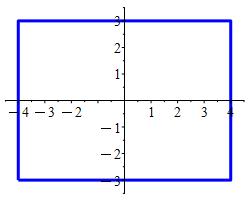
We first need to find all critical points in the interior. We set the partial derivatives equal to \(0\): \[\begin{aligned} f_x&=6y-4xy-y^2&=0 \qquad \text{(1)} \\ f_y&=6x-2x^2-2xy&=0 \qquad \text{(2)} \end{aligned}\] Equation (1) says \(y=0\) or \(4x+y=6\). Equation (2) says \(x=0\) or \(x+y=3\). So we look at \(4\) cases:
-
Case 1: \(x=0\) and \(y=0\):
This gives the critical point \((x,y)=(0,0)\) and the function value \(f(0,0)=0\). -
Case 2: \(x=0\) and \(4x+y=6\):
This implies \(y=6\) which gives the critical point \((x,y)=(0,6)\). However, since \((0,6)\) is not within the rectangle, we can ignore it. -
Case 3: \(y=0\) and \(x+y=3\):
This implies \(x=3\) which gives the critical point \((x,y)=(3,0)\) and the function value \(f(3,0)=0\). -
Case 4: \(4x+y=6\) and \(x+y=3\):
Subtracting the second equation from the first gives \(3x=3\) or \(x=1\). Substituting back gives \(y=2\). This gives the critical point \((x,y)=(1,2)\) and the function value \(f(1,2)=6(1)(2)-2(1)^2(2)-(1)(2)^2=12-4-4=4\).
We now need to check the boundary of the rectangle. There are \(4\) edges. We evaluate the function \(f(x,y)=6xy-2x^2y-xy^2\) on each edge and find the critical points.
-
Edge 1: \(x=4\):
The function becomes \(f(4,y)=24y-32y-4y^2=-8y-4y^2\). We find the critical point: \(f_y=-8-8y=0\) or \(y=-1\). The critical point is \((x,y)=(4,-1)\) and the function value is \(f(4,-1)=6(4)(-1)-2(4)^2(-1)-(4)(-1)^2=-24+32-4=4\). -
Edge 2: \(x=-4\):
The function becomes \(f(-4,y)=-24y-32y+4y^2=-56y+4y^2\). We find the critical point: \(f_y=-56+8y=0\) or \(y=7\). However, the critical point \((-4,7)\) is not on the edge of the rectangle. So we can ignore it. -
Edge 3: \(y=3\):
The function becomes \(f(x,3)=18x-6x^2-9x=9x-6x^2\). We find the critical point: \(f_x=9-12x=0\) or \(x=\dfrac{3}{4}\). The critical point is \((x,y)=\left(\dfrac{3}{4},3\right)\) and the function value is \(f\left(\dfrac{3}{4},3\right) =6\left(\dfrac{3}{4}\right)(3)-2\left(\dfrac{3}{4}\right)^2(3) -\left(\dfrac{3}{4}\right)(3)^2 =\dfrac{27}{2}-\,\dfrac{27}{8}-\,\dfrac{27}{4} =\dfrac{27}{8}\). -
Edge 4: \(y=-3\):
The function becomes \(f(x,-3)=-18x+6x^2-9x=-27x+6x^2\). We find the critical point: \(f_x=-27+12x=0\) or \(x=\dfrac{9}{4}\). The critical point is \((x,y)=\left(\dfrac{9}{4},-3\right)\) and the function value is \(f\left(\dfrac{9}{4},-3\right) =6\left(\dfrac{9}{4}\right)(-3)-2\left(\dfrac{9}{4}\right)^2(-3) -\left(\dfrac{9}{4}\right)(-3)^2 =-\,\dfrac{81}{2}+\dfrac{243}{8}-\,\dfrac{81}{4} =-\,\dfrac{243}{8}\).
Finally, we now need to check the endpoints of the edges which are the corners of the rectangle. We evaluate the function \(f(x,y)=6xy-2x^2y-xy^2\) at the corners.
-
Corner 1: \((x,y)=(4,3)\):
The function value is \(f(4,3)=6(4)(3)-2(4)^2(3)-(4)(3)^2=-60\). -
Corner 2: \((x,y)=(4,-3)\):
The function value is \(f(4,-3)=6(4)(-3)-2(4)^2(-3)-(4)(-3)^2=-12\). -
Corner 3: \((x,y)=(-4,3)\):
The function value is \(f(-4,3)=6(-4)(3)-2(-4)^2(3)-(-4)(3)^2=-132\). -
Corner 4: \((x,y)=(-4,-3)\):
The function value is \(f(-4,-3)=6(-4)(-3)-2(-4)^2(-3)-(-4)(-3)^2=204\).
The critical points are plotted at the right. We summarize the function values at all the critical points.
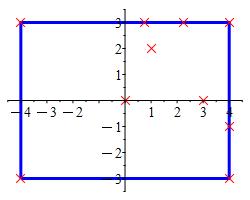
\[\begin{aligned} f(0,0)=0 \qquad f(3,0)&=0 \qquad f(1,2)=4 \\ f(4,-1)=4 \qquad f\left(\dfrac{3}{4},3\right)&=\dfrac{27}{8} \qquad f\left(\dfrac{9}{4},-3\right)=-\,\dfrac{243}{8} \\ f(4,3)=-60 \qquad f(4,-3)=-12 \qquad &f(-4,3)=-132 \qquad f(-4,-3)=204 \end{aligned}\] So the absolute maximum is \(204\) at \((-4,-3)\) and the absolute minimum is \(-132\) at \((-4,3)\).
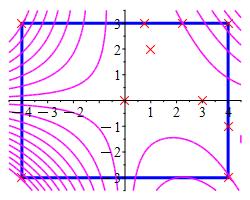
We check the absolute maximum and minimum are reasonable by superimposing the contour plot of \(f(x,y)=6xy-2x^2y-xy^2\) on the plot of the critical points.
Find the locations and values of the global maximum and minimum of the function \(f(x,y)=4x+2y-x^2-y^2\) inside or on the triangle with vertices \((0,0)\), \((3,0)\) and \((3,3)\).

The edge between \((0,0)\) and \((3,3)\) is \(y=x\).
The absolute maximum is \(5\) at \((2,1)\) and the absolute minimum is \(0\) at \((0,0)\) and \((3,3)\).
We first find all critical points in the interior. We set the partial derivatives equal to \(0\): \[\begin{aligned} f_x&=4-2x&=0 \quad \Rightarrow \quad x=2 \\ f_y&=2-2y&=0 \quad \Rightarrow \quad y=1 \end{aligned}\] So the only critical point is \((x,y)=(2,1)\) and the function value is \(f(2,1)=4(2)+2(1)-(2)^2-(1)^2=5\).
We now check the boundary of the triangle. There are \(3\) edges. We evaluate the function \(f(x,y)=4x+2y-x^2-y^2\) on each edge and find the critical points.
-
Edge 1: \(y=0\):
The function becomes \(f(x,0)=4x-x^2\). We find the critical point: \(f_x=4-2x=0\) or \(x=2\). The critical point is \((x,y)=(2,0)\) and the function value is \(f(2,0)=4(2)-2^2=4\). -
Edge 2: \(x=3\):
The function becomes \(f(3,y)=2y-y^2+3\). We find the critical point: \(f_y=2-2y=0\) or \(y=1\). The critical point is \((x,y)=(3,1)\) and the function value is \(f(3,1)=2(1)-1^2+3=4\). -
Edge 3: \(y=x\):
The function becomes \(f(x,x)=6x-2x^2\). We find the critical point: \(f_x=6-4x=0\) or \(x=\dfrac{3}{2}\). The critical point is \((x,y)=\left(\dfrac{3}{2},\dfrac{3}{2}\right)\) and the function value is \(f\left(\dfrac{3}{2},\dfrac{3}{2}\right) =6\left(\dfrac{3}{2}\right)-2\left(\dfrac{3}{2}\right)^2 =\dfrac{9}{2}\).
Finally, we now check the corners of the triangle. We evaluate the function \(f(x,y)=4x+2y-x^2-y^2\) at the corners.
-
Corner 1: \((x,y)=(0,0)\):
The function value is \(f(0,0)=0\). -
Corner 2: \((x,y)=(3,0)\):
The function value is \(f(3,0)=4(3)+2(0)-(3)^2-(0)^2=3\). -
Corner 3: \((x,y)=(3,3)\):
The function value is \(f(3,3)=4(3)+2(3)-(3)^2-(3)^2=0\).
The critical points are plotted at the right. We summarize the function values at all the critical points.

\[\begin{aligned} f(2,1)=5 \qquad f(2,0)=4 \qquad &f(3,1)=4 \qquad f\left(\dfrac{3}{2},\dfrac{3}{2}\right)=\dfrac{9}{2} \\ f(0,0)=0 \qquad f(3,0)&=3 \qquad f(3,3)=0 \end{aligned}\] So the absolute maximum is \(5\) at \((2,1)\) and the absolute minimum is \(0\) at \((0,0)\) and \((3,3)\).
We check the absolute maximum and minimum are reasonable by superimposing the contour plot of \(f(x,y)=4x+2y-x^2-y^2\) on the plot of the critical points.

Heading
Placeholder text: Lorem ipsum Lorem ipsum Lorem ipsum Lorem ipsum Lorem ipsum Lorem ipsum Lorem ipsum Lorem ipsum Lorem ipsum Lorem ipsum Lorem ipsum Lorem ipsum Lorem ipsum Lorem ipsum Lorem ipsum Lorem ipsum Lorem ipsum Lorem ipsum Lorem ipsum Lorem ipsum Lorem ipsum Lorem ipsum Lorem ipsum Lorem ipsum Lorem ipsum